How to Use AI to Improve Your English Writing Without Losing Your Voice
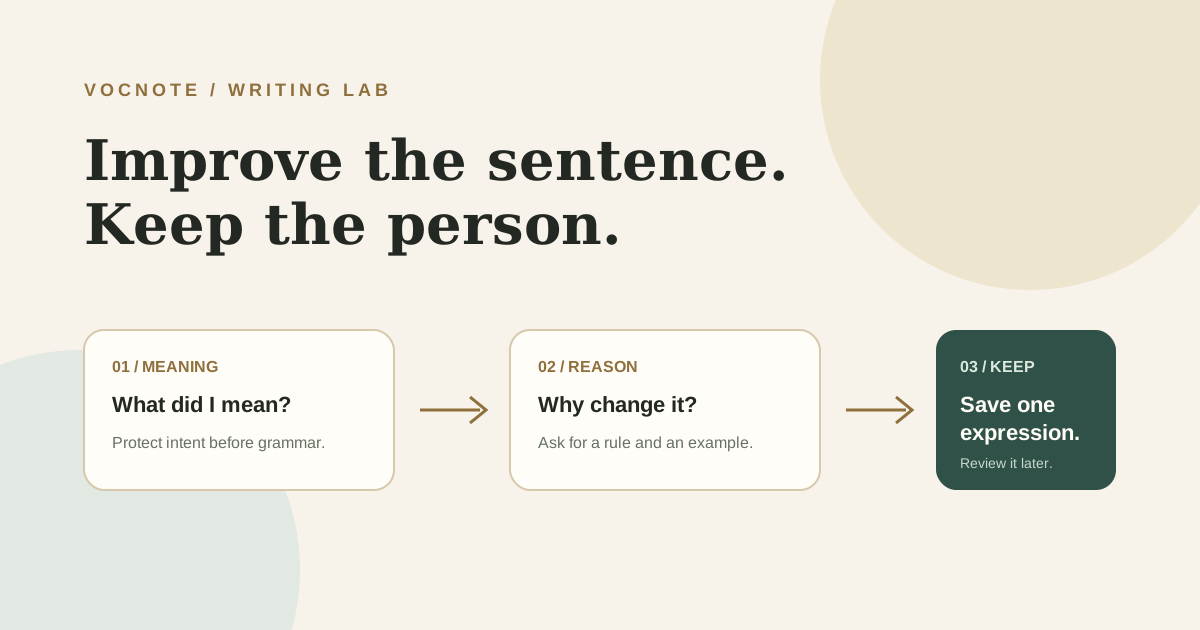
AI can make an English paragraph smoother while quietly making it sound unlike you. The better workflow is simple: preserve your original meaning, understand each important change, and keep only the expressions you can use again.
Feedback should build judgment, not replace it.
Ask AI to explain a small number of changes before it rewrites the whole paragraph. Then close the answer and write the sentence again yourself.
- 01Keep the original
- 02Ask why it changed
- 03Reuse one expression
Why “make this sound native” is an incomplete writing exercise
Because it combines several different jobs: correcting an error, improving clarity, changing tone, and rewriting the sentence. AI can do all four in a single response, but a fluent result does not tell you which job it performed—or whether the new sentence still sounds like something you would say.
Imagine writing: I want to know more about this project, so I think we can have a meeting next week. A tool might offer: I would appreciate the opportunity to discuss this project further next week. The second sentence is polished, but it is also more formal and more indirect. If you were writing a quick note to a teammate, that may be the wrong improvement.
There is no single “native” voice. Good English changes with the relationship, the medium, and the purpose. Your first task is therefore not to accept the smoothest option. It is to decide what you meant and what tone you want to keep.
Give the AI a coach’s job, not a ghostwriter’s job
This prompt works for a short email, journal entry, application paragraph, or work message. Replace the explanation language with your preferred language if English explanations create extra friction.
You are my English writing coach, not my ghostwriter.

Here is my original text:
[PASTE YOUR TEXT]

Please do three things:
1. Keep my meaning and overall tone. Identify only errors or phrases that may sound unnatural.
2. For each suggested change, show:
   - my original sentence
   - your suggested version
   - a short explanation in simple English
   - whether the change is grammar, word choice, tone, or naturalness
3. Give me two alternatives only when the tone could reasonably change.

Do not rewrite the whole paragraph before explaining the changes.
At the end, choose the one expression most useful for me to remember and give me two new examples.
Then ask me to rewrite the original sentence without looking at your answer.
The important parts are the constraints. “Keep my meaning” protects the message. The categories separate a real error from a stylistic preference. “One expression” keeps the review set small. The final instruction turns feedback into another production attempt instead of a copying exercise.
Use one piece of writing three different ways
Write before asking
Keep your first version. It is evidence of what you can currently produce and the context the AI needs.
Classify the change
Separate grammar, clarity, word choice, tone, and naturalness. Each category calls for a different kind of practice.
Rewrite from memory
Close the answer, change one detail, and produce a new sentence using the same useful pattern.
Pass one: ask what affects understanding
Start with clarity, not perfection. Ask the AI to mark anything that could confuse a reader, any clear grammar error, and any phrase that is understandable but unusual. This gives you a priority list instead of a wall of red edits.
Pass two: ask why
Choose no more than three to five changes. Ask whether the issue is a tense, collocation, preposition, register, or sentence structure. Request one new example that is similar in function but different in topic. An explanation without a new example often feels understood before it is usable.
Pass three: write again
Hide the suggestions. Rewrite the sentence with a different subject, time, or situation. You are not trying to reproduce the AI’s exact wording; you are checking whether the underlying choice is now available to you.
Let each tool handle a narrow part of the job
OpenAI’s official Study Mode guidance describes a learning experience that can guide thinking with questions, explain ideas in layers, and check understanding. That maps well to the “ask why, then try again” part of this workflow. It also says Study Mode can make mistakes, so it is a teaching aid—not a final authority.
If you want spoken practice, the official ChatGPT Voice FAQ is the right place to check current availability and limits. Voice can help you say a revised sentence naturally, but keep a written review step so the useful expression does not disappear when the conversation ends.
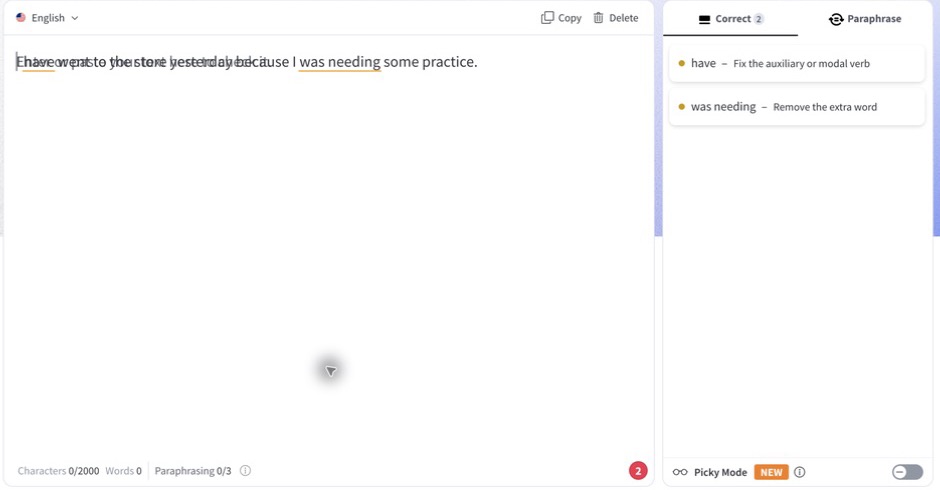
A grammar checker is useful for a narrower first pass. LanguageTool’s public editor offers grammar and spelling checks, as well as paraphrasing and tone-oriented features. In a browser test on July 26, 2026, I entered I have went to the store yesterday because I was needing some practice. The editor surfaced two suggestions: have for the auxiliary/modal verb and was needing as an extra word.
| Task | Useful instruction | Keep as evidence |
|---|---|---|
| Check clarity | “Mark anything a reader could misunderstand.” | Your original sentence and the reason |
| Understand a correction | “Classify this as grammar, word choice, tone, or naturalness.” | One rule and one new example |
| Practice tone | “Give formal, neutral, and friendly versions, and explain when each fits.” | The situation that makes one version appropriate |
| Build retention | Save one complete phrase in VocNote. | Context plus your own example |
Save a sentence pattern, not a pile of synonyms
Suppose AI suggests discuss this further instead of talk more about this. You do not need to collect every possible synonym. Ask what communication problem the phrase solves, where it belongs, and what other sentence you could build with it.
When you save a phrase in VocNote, keep four pieces: the phrase, the original sentence, a plain-language meaning, and one example about your own life. When you open Vocabulary Review later, hide the phrase and reconstruct it from the situation first. The small delay is the point: recognition is not the same as recall.
If you want to connect writing and speaking, try reading your original sentence aloud, saying the revised version, and then explaining the same idea without looking at either. The related AI conversation vocabulary workflow uses the same principle: conversation creates the material, but retrieval makes it portable.
“More natural” is a suggestion, not a universal rule
- Do not copy the final version blindly. You get a result without learning the decision behind it.
- Do not edit a whole essay at once. Too much feedback makes it hard to choose what to practice first.
- Do not treat naturalness as one correct answer. Region, relationship, and context change what sounds right.
- Do not trust confidence as proof. AI can explain a questionable language choice fluently. For high-stakes writing, check a reliable reference or ask a qualified speaker.
Also keep private information out of prompts unless you understand the tool’s settings and are comfortable with the data handling. For product limits, privacy details, and current interfaces, use the official documentation linked above rather than an old tutorial.
Let AI help you notice the problem, but keep the meaning, the explanation, the rewrite, and the next use in your hands. The goal is not for every paragraph to sound like a generic native speaker. It is for you to become more able to explain—and repeat—your own choices.
This article describes a learning workflow, not a guarantee of error-free writing. ChatGPT and third-party tool features, limits, and interfaces can change; check the linked official pages for current details.